Portable Gantry Cranes for Underground Hoisting: Winch or Hoist?
menu_open
Content Quick Link
Introduction
Working underground comes with a unique set of challenges. Narrow tunnels, low ceilings, uneven floors, and limited access make lifting heavy loads tricky. That’s where portable gantry cranes shine. They are compact, adjustable, and easy to move, providing practical lifting solutions without the need for permanent installations.
Typical underground applications include:
- Mining operations – moving machinery or extracted materials.
- Tunnels and subways – installing equipment, pipes, or structural components.
- Basements and underground construction – lifting HVAC units, electrical panels, or concrete elements.
- Utility works – handling pipes, cables, and other heavy equipment in tight spaces.
Choosing the right lifting mechanism is just as important as choosing the crane itself. The wrong choice can lead to:
- Reduced efficiency
- Safety risks
- Faster wear and tear on equipment
This brings us to the key question for buyers: should you use an electric winch or an electric hoist for underground lifting?
In this guide, we’ll explore both options in detail, discuss their advantages and drawbacks, and provide practical advice to help you select the right system for your underground operation.
What you’ll take away from this section:
- Why portable gantry cranes are ideal for underground work.
- How the lifting mechanism impacts safety and productivity.
- An introduction to the winch vs hoist debate for underground lifting.
Underground Lifting Challenges
Lifting in underground environments is very different from open workshops or factories. Every site comes with its own limitations, and ignoring them can cause delays, equipment damage, or safety hazards. Understanding these challenges is the first step in choosing the right portable gantry crane and lifting mechanism.
Limited Space
Underground sites often have strict height and width restrictions. Tunnels, basements, and utility shafts can be narrow, which limits crane size and mobility. Selecting a crane that fits these constraints is critical.
- Headroom might be as low as 2–3 meters in some tunnels.
- Width restrictions can prevent standard crane frames from passing through.
- Collapsible or adjustable gantry cranes are often the only viable option.
Accessibility
Moving heavy loads through tight corners, uneven floors, or rough terrain adds complexity. Positioning the crane correctly can be challenging, and operators must plan paths carefully to avoid obstacles.
- Cranes may need to be disassembled and reassembled underground.
- Wheels or adjustable legs help navigate uneven surfaces.
- Trolley and lifting mechanism placement must allow smooth load movement.
Load Characteristics
Underground lifts vary greatly in weight, shape, and frequency. Some sites handle small equipment, while others move large machinery or construction materials. Knowing the type of load is essential for proper crane and mechanism selection.
- Irregular-shaped items may require special attachments or slings.
- Frequent lifts demand equipment rated for high duty cycles.
- Heavy loads require hoists or winches with sufficient lifting capacity and safety margins.
Environmental Factors
Underground conditions can be harsh, affecting both equipment performance and operator safety. Moisture, dust, and temperature fluctuations are common, and sometimes corrosive substances are present.
- Electrical components must be protected against dust and moisture.
- Metal parts should have corrosion-resistant coatings.
- Temperature extremes can affect motor and cable performance.
Safety Considerations
Safety is a top priority in confined underground spaces. Limited escape routes and restricted visibility increase the risk of accidents, so every lift must be carefully planned and executed.
- Ensure load paths are clear and properly supported.
- Operators should use safety harnesses or spotters if space is tight.
- Equipment must include emergency stop functions and overload protection.
Overview of Portable Gantry Cranes
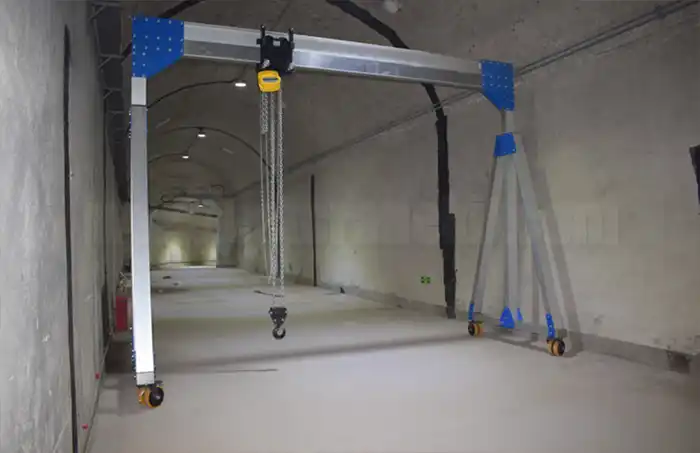
Aluminum Portable gantry cranes are designed to provide lifting solutions in spaces where traditional overhead cranes or fixed installations are not feasible. They are compact, adjustable, and easy to move, making them ideal for underground environments where space and accessibility are limited.
Definition & Components
A portable gantry crane is essentially a movable framework that supports a lifting mechanism. Its main components include:
- Frame: The main structure that holds the crane upright and supports the load.
- Legs: Often adjustable or telescopic to fit uneven or low-clearance spaces.
- Trolley: Moves along the beam to position the load precisely.
- Lifting mechanism: Either an electric winch or an electric hoist, depending on load requirements and precision needs.
6 Types of Portable Gantry Cranes for Underground Work
Underground lifting operations require cranes that are compact, flexible, and easy to maneuver. Common types include:
- Adjustable height cranes: Allow operators to set the lifting height based on tunnel or shaft clearance.
- Collapsible/telescopic cranes: Foldable designs make it easier to move through narrow passages and store when not in use.
- Lightweight aluminum or steel models: Aluminum cranes are lighter and easier to transport, while steel models offer higher strength for heavier loads.
Advantages of Portable Gantry Cranes in Underground Applications
Portable gantry cranes offer several benefits that make them a practical choice for underground lifting:
- Easy relocation: Can be moved from one spot to another without heavy equipment.
- Quick setup: Minimal assembly required, reducing downtime on site.
- Flexibility for various load types: Suitable for equipment, construction materials, or irregular-shaped items with the right attachments.
By understanding these components, types, and benefits, buyers can better decide which portable gantry crane configuration works best for their underground lifting needs. Selecting the right combination of crane and lifting mechanism ensures safer and more efficient operations.
Electric Winch Lifting Mechanism
Electric winches are one of the most common lifting options for portable gantry cranes, especially in underground environments. They use a drum-based cable system powered by an electric motor to lift and lower loads. This straightforward design makes them reliable and relatively easy to maintain.
 Electric winch portable gantry cranes
How It Works
The core of an electric winch is a rotating drum that winds or unwinds a steel cable or wire rope. As the drum turns, the load is lifted or lowered smoothly. Most electric winches have integrated controls for speed adjustment, allowing operators to handle loads with better precision than purely manual systems.
Key Features
- Smooth, controlled lifting: Reduces sudden jerks and keeps loads stable.
- Adjustable speed options: Allows operators to match lift speed to load weight and site conditions.
- Suitable for variable load weights: Can handle different types of equipment and materials without needing a separate lifting device.
Pros in Underground Applications
- Compact design fits tight spaces: Winches are generally smaller than hoists, making them ideal for tunnels and low-clearance areas.
- Durable for repetitive operations: Designed for frequent lifting without excessive wear.
- Often more cost-effective: Lower initial investment and simpler maintenance requirements compared to hoists.
Cons
- Limited precise positioning: Winches may struggle with fine load placement compared to hoists, which offer better control.
- Slower for very high-speed lifting tasks: While adjustable, winches are generally not built for rapid lifting of heavy loads.
Conclusion
For underground projects where space is tight, loads are moderate, and repetitive lifting is required, electric winches provide a practical, reliable, and economical solution. However, if precision placement or heavier loads are a priority, a hoist may be a better choice.
Electric Hoist Lifting Mechanism
Electric hoists are widely used in underground lifting operations where precision and heavy-load handling are important. Unlike winches, hoists are typically mounted on a trolley that moves along the crane's beam, allowing both horizontal and vertical positioning of the load. Powered electrically, they offer smooth operation and can be fitted with various control options.
How It Works
An electric hoist uses either a wire rope or chain to lift loads. The hoist is mounted on a trolley that moves along the gantry crane's beam. When the motor operates, the rope or chain winds onto a drum or sprocket, lifting or lowering the load. Many hoists also include limit switches, speed control, and overload protection, making them safer for demanding underground applications.
Key Features
- High precision lifting and positioning: Ideal for sensitive or irregularly shaped equipment.
- Multiple speed settings and load control: Operators can adjust lift speed according to weight and site conditions.
- Overload protection options: Prevents damage to both the hoist and the load.
Pros in Underground Applications
- Precise lifting control for sensitive equipment: Essential when placing machinery or materials in confined spaces.
- Handles heavier loads safely: Wire rope or chain designs support higher capacities than most winches.
- Easier integration with automation or remote control: Hoists can be operated remotely, reducing the need for personnel in tight areas.
Cons
- Slightly larger footprint: Hoists take up more space than compact winches, which can be a factor in very tight underground tunnels.
- Higher cost compared to winches: Initial investment and replacement parts are generally more expensive.
- May require more maintenance in harsh conditions: Dust, moisture, or corrosive environments can increase upkeep needs.
Conclusion
Electric hoists are the go-to choice when precision, heavy loads, and reliable control are a priority. For underground sites where space is tight but accuracy and safety cannot be compromised, they often outperform winches, despite the higher cost and maintenance requirements.
Comparison Table: Winch vs Hoist for Underground Gantry Cranes
Choosing the right lifting mechanism for an underground portable gantry crane often comes down to balancing space, load, precision, and cost. The table below summarizes the main differences between electric winches and electric hoists, highlighting their practical applications.
| Feature | Electric Winch | Electric Hoist |
|---|---|---|
| Precision | Moderate – suitable for general lifting where exact placement is less critical | High – ideal for precise load positioning in tight spaces |
| Speed | Moderate – good for regular lifting tasks | Moderate–High – adjustable speeds for careful or rapid lifts |
| Load Capacity | Medium – suitable for typical underground loads | Medium–High – can handle heavier or bulkier items safely |
| Footprint / Space Efficiency | Smaller – fits very tight tunnels and low ceilings | Slightly Larger – needs more headroom and width |
| Maintenance Requirements | Low–Moderate – simple design and fewer components | Moderate – requires regular inspection, especially in dusty or wet conditions |
| Cost | Lower – budget-friendly, lower initial investment | Higher – higher purchase and maintenance costs |
| Best Use Case | Frequent moderate loads in tight spaces | Heavy or sensitive loads requiring precise positioning |
Practical Takeaways
- Use an electric winch if you’re working in narrow tunnels, need frequent moderate lifts, and want a cost-effective solution.
- Use an electric hoist if your loads are heavier, require exact positioning, or you want smoother, safer handling for sensitive equipment.
- Many underground projects combine both, using winches for general lifting and hoists for critical placements, depending on the workflow.
This comparison helps buyers quickly evaluate which lifting mechanism matches the site conditions, load type, and operational priorities.
Buyer Considerations for Underground Gantry Cranes
When selecting a portable gantry crane for underground lifting, there's more to consider than just lifting capacity. The right crane and lifting mechanism can improve efficiency, reduce risks, and save money in the long run. Here are the key factors buyers should evaluate:
Site Constraints
Underground environments are often tight and irregular. Before choosing a crane, consider:
- Headroom: Ensure the crane and lifting mechanism fit the ceiling height of tunnels or shafts.
- Floor condition: Uneven or soft surfaces may require adjustable legs or reinforced bases.
- Access routes: Check whether the crane can be transported to the work area without disassembly.
Load Type and Frequency
Understanding the nature of your lifts is critical:
- Weight: Match the crane and hoist/winch capacity to your heaviest loads, with an extra safety margin.
- Shape: Irregular or bulky items may need specialized slings or attachments.
- Frequency: Frequent lifts demand equipment rated for continuous operation to avoid overheating or wear.
Operational Speed Requirements
Think about how quickly you need the lifts to occur:
- Fast operations are possible but may increase wear and require more precise control.
- In tight underground spaces, slower, controlled lifts are often safer and more practical.
Flexibility
Underground projects often change layouts or require equipment in multiple locations. Consider:
- Adjustable height or telescopic legs for different clearances.
- Collapsible frames for easy transport through narrow passages.
- Modular designs that allow relocation without disassembly.
Budget and Maintenance Capacity
The cheapest crane isn't always the best choice. Factor in:
- Initial purchase cost.
- Maintenance frequency and spare parts availability.
- Long-term durability under underground conditions.
Safety Features
Safety should never be compromised in confined spaces:
- Overload protection: Prevents crane or lifting mechanism damage.
- Emergency stop: Allows immediate shutdown if a hazard occurs.
- Environmental protection: Dust, moisture, or corrosive resistance for reliable operation.
Practical Tips for Buyers
Buying a portable gantry crane for underground lifting isn't just about picking the heaviest or cheapest option. Practical considerations can save time, money, and even prevent accidents. Here are some hands-on tips to keep in mind:
Test Crane Setup in Similar Conditions
Before making a purchase, try to simulate the underground environment as closely as possible. This helps ensure the crane will fit, operate smoothly, and handle the expected load.
- Check clearance under ceilings and through tunnels.
- Test movement along uneven or rough floors.
- Observe how the lifting mechanism performs under typical loads.
Confirm Lifting Heights and Span Coverage
Make sure the crane's maximum height and span meet your operational needs. In underground sites, space is often limited, so even a small miscalculation can cause major issues.
- Verify the crane can reach the required lifting points.
- Ensure the span covers all areas where materials need to be moved.
Ensure Winch or Hoist Meets Duty Cycles
Frequent lifting operations require robust equipment. Check that the selected winch or hoist is rated for continuous or high-duty cycles without overheating or excessive wear.
- Consider load weight and frequency of lifts.
- Verify manufacturer specifications for operating hours and load limits.
Factor in Ease of Relocation and Storage
Underground sites often have tight passages and limited storage space. Choose a crane that can be moved easily or folded when not in use.
- Telescopic or collapsible designs make relocation easier.
- Lightweight aluminum cranes may be better for temporary jobs.
- Plan storage areas to avoid obstructing work zones.
Consider Optional Features
Additional features can improve efficiency, safety, and adaptability in underground environments:
- Remote control operation for safer handling in confined spaces.
- Explosion-proof design if working in dusty or hazardous conditions.
- Heavy-duty trolleys to support heavier loads or rough terrain.
Conclusion & Recommendation
Choosing the right lifting mechanism for a portable gantry crane in underground operations comes down to understanding your site, your loads, and your operational needs.
Key differences between winches and hoists:
- Electric Winches: Compact, cost-effective, and well-suited for frequent moderate lifts in tight spaces. They are simpler to maintain and easier to relocate in confined areas.
- Electric Hoists: Offer higher precision, better control, and can handle heavier or more sensitive loads. They are ideal for operations where accuracy and safety are critical, even though they require more space and investment.
Practical guidance for buyers:
- Evaluate space constraints: Choose winches for very low ceilings or narrow tunnels; hoists for areas where precision is more important than compactness.
- Consider load type and frequency: Winches work well for moderate, repetitive loads; hoists handle heavier or irregular items safely.
- Factor in precision requirements: Use hoists when exact placement of equipment or materials is critical.
Finally, it’s always a good idea to consult with crane suppliers or manufacturers. They can provide customized solutions, suggest suitable lifting mechanisms, and help ensure your underground operations are safe, efficient, and reliable.
By carefully matching your site conditions, load characteristics, and operational goals with the right portable gantry crane and lifting mechanism, you can optimize performance while keeping safety and costs under control.

Article by Bella ,who has been in the hoist and crane field since 2016. Bella provides overhead crane & gantry crane consultation services for clients who need a customized overhead travelling crane solution.Contact her to get free consultation.